
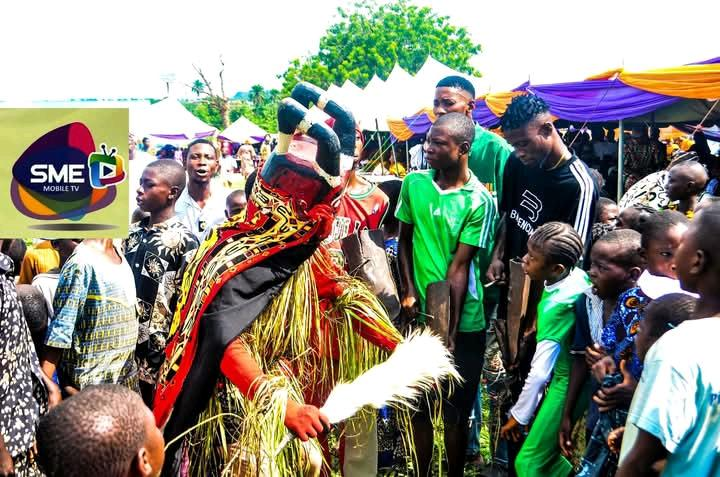
Adan dance takes place in the evening of Emidin festival in Ekinrin-Adde. It is what makes the festival unique, thick, and different from the Emidin festivals in ether villages and towns in ljumu.
Adan dance affords both old and young people the opportunity to let off steam and perhaps shed some of the weight already. accumulated after eating Emidin pounded yam in the morning. The shouting and running involved in the dance is a sort of physical exercise. Furthermore, the elders of Aofin Abudo, who are the custodians of Adan, perform some traditional rites during this aspect of Emidin. The exclusive custodians of Adan are the Agbalogbo Aofin Abudo people, the Esein and Omoe Magbas.
The originator of Adan Dance was OluAlaa Odundun, the Olu-Adde (1865-1880), one of Aofin Abudo’s immediate progenitors. He was a powerful and renowned warrior and it was in one of his war expeditions that he saw the warlike dance and decided to bring it home and then introduced it to his people to be celebrated during Emidin Festival. Since then, Adan dance has remained an integral part of the Emidin Festival in Ekinrin-Adde.
In the immediate past, various weapons of war like cutlasses, swords, spears. bows and arrows, etc. were used during Adan dance. However, in the wisdom of the present elders of AofinAbudo, wood shaped like swords and other less dangerous materials are now used during the dance.
The original home ofAdan is Akodi in Ekinrin-Adde with Aladegbara (a.k.aAddeke kun) as the meeting place for performing traditional rites and offering of sacrifices to ogun to round off Adan dance. However, during the reign of OluAjibulu (1926-1948), the venue for performing Adan rites moved to the front of his palace. But till today, Aladegbara in Odo-Akodi remains the starting point of Adan Dance, where the drums for the dance are first beaten. Ifa Emidin is another important aspect of the Emidin Festival. It is done a few weeks to Emidin day, and it is usually elaborate and would take a whole day. The main purpose is to consult the Ifa oracle as to the success or otherwise of the approaching Emidin day.
But IfaEmidin is gradually fading out as it is rarely observed nowadays. The beating of Ogidigbo is another remarkable aspect of the Emidin festival. Ogidigbo is a hollow wood musical instrument that belongs to the AofinAbudo. Apart from beating it to signify the period of Emidin, it is also brought out during the burial of an Olu-Adde who is an Aofin Abudo member. For instance, when HRM Oba David Olarenwaju Olorunmaye, the late Adàn dance takes place in the evening of Emidin festival in Ekinrin-Adde. It is what makes the festival unique, thick, and different from the Emidin festivals in other villages and towns in ljumu.
Adàn dance affords both old and young people the opportunity to let off steam and perhaps shed some of the weight already accumulated after eating Emidin pounded yam in the morning. The shouting and running involved in the dance is a sort of physical exercise. Furthermore, the elders of AofinAbudo, who are the custodians of Adan, perform some traditional rites during this aspect of Emidin. The exclusive custodians of Adàn are the AgbalogboAofinAbudo people, the Esien and Omoe Magbas.
The originator of Adan Dance was OluAlaa Odundun, the Olu-Adde (1865 1880), one of Aofin Abudo s immediate progenitors. He was a powerful and renowned warrior and it was in one of his war expeditions that he saw the warlike dance and decided to bring it home and then introduced it to his people to be celebrated during Emidin Festival. Since then, Adan Dance has remained an integral part of the Emidin Festival in Ekinrin-Adde.
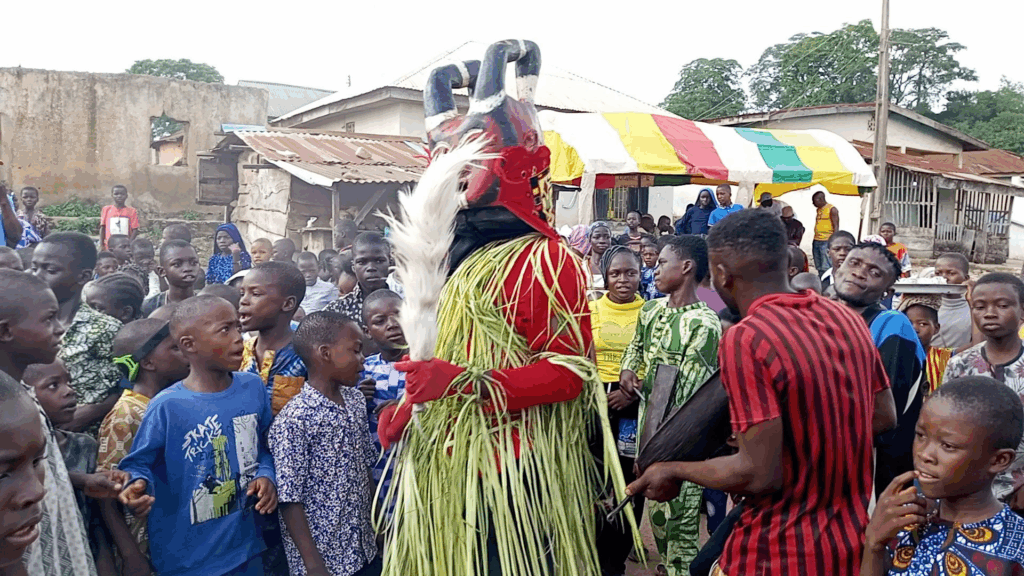
In the immediate past, various weapons of war like cutlasses, swords, spears, bows and arrows, etc. were used during Adan dance. However, in the wisdom of the present elders of AofinAbudo, wood shaped like swords and other less dangerous materials are now used during the dance.
S.O FALEKE AROTILE
OMI IGBO: A LEGACY POND IN EKINRIN-ADDE
Omigbó is a popular pond in Ekinrin-Adde. It can be located after Odo Akodi and it is directly behind Alhaji Ahmeed Samu (a.k.a A o figi Aràbà sogun)’s house.
The origin of Omigbó dates back to time th immemorial and from what I have gathered from our elders, it was brought from the original b Omigbó in Abudo.
I am told that when Omigbó, was “brought to Ekinrin-Adde, it was first located in Aledegbara but later taken to its present location.
While I can not claim that I know everything about Omigbó, I will like to state here some unassailable facts about it.
The pond is often referred to as ‘Omíabíyamo’, ‘ololmoyoyo’. It is so referred to because it is the most readily available water believed to have some potent magical and healing powers to bring a healthy life to a newborn baby. Hence, immediately a baby was born in the past, (even in the midnight), the family would go to fetch water from Omigbó to give the baby its first bath. The water from Omigbó would also be used in preparing agbo for the baby and the mother.
Undisputedly, the Aofin Abudos are the exclusive custodians of Omigbo just like Adàn Dance. They also jointly own Ajibele and its Igbo-oka with five groups of people referred to as “Akumarun Oyaya”. Like each group in Ekinrin-Adde is known to have specific “Imole” deity, Asorin belongs to Aofin Abudo, while Ota and Aigba belong to Ekinrin and Odo-Adde respectively.
At regular intervals, the leaders of Aofin Abudo mobilize their followers to take good care of Omigbó. In the time past, it used to be a big ceremony of reshaping and rejuvenating the entire pond. All fish in the pond would be brought out alive and carefully kept in big pots (Oorù) and the mud and other dirty things inside the pond would be removed to bring fresh life to it. After this, the fish would be returned Into the pond.
It is forbidden to kill and eat Omigbó’s fish. The belief is that if one succeeded in killing Omigbo fish, no matter how long one cooked the fish, it would not be done, and one would never be able to eat it! I used to believe this until lately when someone told me that the elders in their wisdom created the myth so as to scare people away from killing Omigbo’s fish indiscriminately.
My informant said in reality, the elders ate the big fish, but returned the juveniles to the pond. They usually waited for people to depart from the pond after finishing work on it before sorting out the big fish from the big pots where they were kept. They then shared the fish among themselves and took it home for their wives to cook.
Anytime a general work was undertaken on Omigbó, some purification exercises were carried out by the elders. Such purification may include slaughtering a goat, he-goat or a fowl. Recently and precisely two months ago, our Aofin Abudo people carried out a cleaning exercise in and around Omigbo pond. The usual purification involving the use of a goat, I was informed, took place. It has become a tradition for the Agbalogbos to take care of Omigbo two weeks before Emidin/Adan Festival. It has become an annual event.
Let it be known that the Omigbo we grew up to know is not the one we have today. Erosions have been the bane of the pond and if not for the resilience of the Abudo people, Omigbó would have long been forgotten. Concerted efforts are often made to prevent erosions from polluting and completely destroying the pond.
The care for Omigbó is believed to sometimes bring rain down whenever there was a prolonged dry season and farmers were desirous of rainfall. Yes, I can confirm this belief of our people. I had personally witnessed such occasions while growing up. I can also testify that somehow whether by coincidence or some unexplainable means, we used to have rainfall on some of such occasions. How the elders were able to accomplish this, I can not say. But I have been made to understand that “what the elders use to eat èko is usually under the leaf”.
Young ladies and boys used to sing and dance round the village any time there was work on Omigbó in the past. It was customary then for the young ladies to carry mud brought out from inside Omigbo in containers as they danced round the village. They would put some of the mud at the door posts of their colleagues who refused to join in the work at the pond.
While moving and dancing round the village, the young ladies would sing “Oni ba fojo Omigbo o, ebi o Aungbe”. The song simply says anyone who attempts to stop (fojo) Omigbo’s rain from falling is inviting thirst and hunger to himself or herself.
The most frequently asked question today is whether Omigbo still exists. And the plain and affirmative answer is that Omigbo still exists, but as I said earlier, it is not the same one you and l used to know.
From what I know, our Aofin Abudo people take good care of Omigbo as necessary perhaps to preserve and sustain it as one of our cherished legacies as a people. I suspect that there is a sort of emotional attachment to Omigbó by the people of Abudo.
Obviously, Omigbo no longer serves the purposes it used to serve because there are other better sources of water in Ekinrin-Adde nowadays. Nonetheless, those who believe it has some mystical power fetch it and use it for whatever purpose. Till date, there are people in Ekinrin-Adde who still attribute some healing power to Omigbó’s water.
S.O FALEKE AROTILE